Physiotherapy is a health science. It allows people to regain their maximum physical abilities to perform daily activities and practice the sports they want. Physiotherapy treats back pain, sprains, motor development problems in children, incontinence and many others.
This glossary has been designed with the purpose of explaining physiotherapy terms for those who, for example, get a diagnosis, but don't know what it really is. Plus, it can help when it's time to write a text on this topic. Also, this was created for people who want to learn more about physiotherapy.
ankylosing spondylitis
noun
A long-term condition in which the spine and other areas of the body become inflamed.
Example: These are either related or unrelated to disease activity: Related, Aphthous ulceration (20%) Erythema nodosum (5-10%) Acute arthritis (6-12%) Eye complications (conjunctivitis, episcleritis, uveitis) (3-10%) Pyoderma gangrenosum (0.5%) Unrelated: Sacroiliitis (18%) ANKYLOSING SPONDYLITIS (75% patients are HLA-B27 +ve, and may progress following proctocolectomy) Associated liver disease: Primary sclerosing cholangitis.
en: spondylarthrite ankylosante
arthritis
noun
Arthritis means inflammation or swelling of one or more joints. It describes more than 100 conditions that affect the joints, tissues around the joint, and other connective tissues.
Example: Rheumatoid ARTHRITIS affects approximately 1% of the UK population; the commonest age of onset is between 25-55 years.
en: Arthrite
bursitis
noun
A painful condition that affects the small, fluid-filled sacs — called bursae (bur-SEE) — that cushion the bones, tendons and muscles near your joints.
Example: When the condition called bursitis occurs, the slippery bursa sac becomes swollen and inflamed.
en: bursite
contusion
noun
Caused by a direct blow to the body that can cause damage to the surface of the skin and to deeper tissues as well-depending on the severity of the blow.
Example: Complications The primary, obvious complication of a fall is that of injury: laceration, CONTUSION head injury, possibly with a subdural haematoma fractured limb, particularly fractured neck of femur fractured rib, which may result in pneumonia The less obvious consequences include, inability to summon help, resulting: - pressure sores - pneumonia - hypothermia loss of confidence, which may cause increased dependence and morbidity As the population's life expectancy increases, a subsequent increase in the number of falls seen amongst the elderly can be expected.
en: contusion
dermatome
noun
The lateral wall of each somite in a vertebrate embryo, giving rise to the connective tissue of the skin.
Example: The somite forms the myotome, sclerotome and perhaps dermatome.
en: dermatome
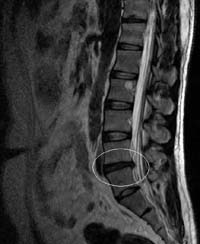
disc herniation
noun
A fragment of the disc nucleus that is pushed out of the annulus, into the spinal canal through a tear or rupture in the annulus.
Example: Extremely rare, but potentially serious side effects include, strokes, spinal disc herniation, vertebral and rib fractures and cauda equina syndrome.
en: hernie discale
dislocation
noun
A separation of two bones where they meet at a joint.
Example: The leg would not appear like this if the injury was an anterior or posterior DISLOCATION, although this type of injury is impossible from a fall and needing a significant force such as a car crash for this to occur.
en: dislocation
edematous disorder
noun
Is swelling caused by excess fluid trapped in your body's tissues. Although edema can affect any part of your body, you may notice it more in your hands, arms, feet, ankles, and legs.
Example: When prolapsed tissues are edematous disorder and necrotic, amputation is performed.
en: trouble oedémateux
electrotherapy
noun
The use of electric currents passed through the body to stimulate nerves and muscles, chiefly in the treatment of various forms of paralysis.
Example: Over the past 16 years he has received numerous episodes of physiotherapy, ELECTROTHERAPY, steroid injections (most recent in 2004) and worn a shoulder sling, which have provided no long-term benefit, "nothing has cured it".
en: électrothérapie
epicondylitis
noun
A painful condition that occurs when tendons in your elbow are overloaded, usually by repetitive motions of the wrist and arm.
Example: Lateral EPICONDYLITIS (tennis elbow) is suggested by a blastic lesion, additional bone growth, on the lateral epicondyle of the humerus.
en: épicondylite
fibromyalgia
noun
A condition that causes pain all over the body (also referred to as widespread pain), sleep problems, fatigue, and often emotional and mental distress.
Example: A less serious but more common muscle problem is a condition called fibromyalgia.
en: fibromyalgie
ligament
noun
Tough fibrous band of connective tissue that support the internal organs and hold bones together in proper articulation at the joints.
Example: The lateral LIGAMENT of the ankle joint is more commonly injured as it is weaker than the medial LIGAMENT.
en: ligament
meniscus
noun
A thin fibrous cartilage between the surfaces of some joints.
Example: The meniscus functions as a shock absorber and weight distributor in the knee joint.
en: ménisque
muscle tone
noun
The amount of tension (or resistance to movement) in muscles.
Example: The basal ganglia usually impose constraints on motor control, but the absence of these constraints yields persistent excesses of movement or slowness of movement and marked changes in MUSCLE TONE.
en: tonus musculaire
periostitis
noun
Inflammation of the membrane enveloping a bone.
Example: This he discovered in a patient with chronic periostitis of the tibia.
en: périostite
plagiocephaly
noun
A very common, very treatable disorder. It causes a baby's head to have a flattened appearance.
Example: The asymmetric appearance of post-depositional damaged crania (Wells 1967) could result in an incorrect diagnosis of the PLAGIOCEPHALY.
en: plagiocéphalie
sprain
noun
The result of a wrench or twist of the ligaments of a joint.
Example: On he went to the GP, who was initially treating him for a muscular SPRAIN, as no other clinical evidence of lung pathology was evident.
en: entorse
stretch muscles
verb
A form of physical exercise in which a specific muscle or tendon is deliberately flexed or stretched in order to improve the muscle's felt elasticity and achieve comfortable muscle tone.
Example: Apparatus such as standing frames, splints and arm wraps are used to build bone and muscle strength and stretch muscles.
en: élonger des muscles
tendonitis
noun
When a tendon swells (becomes inflamed) after a tendon injury.
Example: X-rays are generally only necessaries for persistent rotator cuff TENDONITIS or when the diagnosis is uncertain.
en: tendinite
varicose vein
noun
Twisted, enlarged veins.
Example: I received varicose vein treatment for my left leg.